


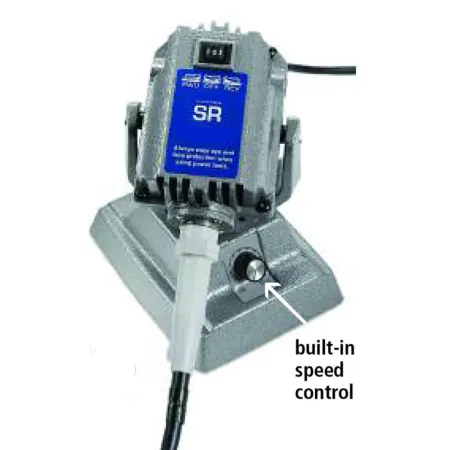
Economical Motor Kit for Flap Peening
Reliable flex-shaft motor delivering up to 18 000 RPM. Affordable performance for general flap peening tasks.
Compact Flexible-Shaft Drive for Everyday Flap Peening
Get reliable torque and stable speed for day-to-day rotary flap peening without the cost or footprint of a bench controller. This economical kit uses the proven Series SR flexible-shaft motor to reach up to 18,000 rpm, making it a practical choice for setup work, local rework, and on-site applications. Verify RPM with a tachometer to meet your process requirements and document compliance.
Technical Data
- Motor: Series SR flexible-shaft, 1/6 hp; forward/reverse; up to 18,000 rpm.
- Voltage options: 230 V or 115 V.
- Operation under load: designed to deliver the power needed without stalling during normal load.
- Required accessory: separate hand piece for mandrels (6.35 mm / 1/4").
- Typical verification: non-contact RPM check with a calibrated tachometer (e.g., Testo 460).
Recommended Use
- Localized peening on edges, radii, and bores; mobile maintenance and MRO tasks.
- Process setup and parameter checks before moving to full-scale production equipment.
Compliance Notes
Rotary flap peening is typically performed to AMS 2590/AMS2592. Maintain the specified operating speed while the flap is in contact with the workpiece (often controlled within tight RPM tolerances) and document RPM using a tachometer. For workflows that require built-in RPM display and tighter closed-loop control, consider upgrading to a bench controller solution.
Frequently Asked Questions
Does this kit hold RPM under load?
The Series SR provides ample power for typical flap peening tasks; however, as with any flexible-shaft drive, you should verify and adjust speed with a tachometer to keep the process within spec.
Which hand piece do I need?
Use the dedicated hand piece compatible with 6.35 mm (1/4") mandrels (sold separately). This is the required interface for flap peening mandrels with 1/4" shafts.
What power options are available?
The kit is available in 230 V and 115 V versions to match local mains supply.
How do I meet AMS 2590 RPM requirements?
Set the target speed, measure directly on the tool with a calibrated tachometer, and record readings at setup and periodically during production to demonstrate conformance.
